Definition
Shiitake (Lentinula edodes) is a brown-capped edible mushroom native to East Asia, cultivated on logs for centuries and famous for its deep umami flavor.
Shiitake (Lentinula edodes) is an edible mushroom with an umbrella-shaped, tan-to-dark-brown cap, cream-colored gills and a firm, fibrous stem. Native to the forests of East Asia, it is one of the most widely cultivated and eaten mushrooms in the world, and a classic example of a food that also appears in functional mushroom conversations.
Where the name comes from
"Shii" refers to the shii tree (Castanopsis cuspidata), a Japanese evergreen related to oak and chestnut whose fallen logs the mushroom naturally grows on. "Take" simply means mushroom. In China it is called xiang gu, or "fragrant mushroom."
A long cultivation history
Shiitake is often cited as one of the first mushrooms humans deliberately cultivated. Records from China describe growing it on cut logs roughly a thousand years ago, and the practice spread to Japan. Traditional log cultivation is still used for premium shiitake, while most modern production relies on sawdust blocks, which grow mushrooms faster and more predictably.
Flavor and cooking
- Umami: Shiitake is rich in guanylate, a natural flavor compound that works with glutamate to create a deep, savory taste.
- Dried shiitake: Drying concentrates the flavor. Soaked dried shiitake is a building block of Japanese dashi and many Chinese braises.
- Prep tip: Remove the tough stems before cooking; save them for stock.
Research and tradition
Beyond the kitchen, shiitake has a place in traditional East Asian food culture. A beta-glucan from shiitake, called lentinan, has been the subject of research in Japan for decades. For most people, though, shiitake is simply a pantry staple with an unmistakable savory depth.
What shiitake teaches about flavor pairing
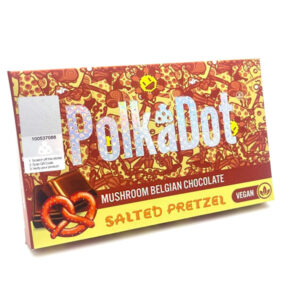
Shiitake shows how mushrooms add savory complexity to food, the same principle behind pairing earthy mushroom blends with chocolate. Just as salt sharpens caramel, a grounded, woodsy note makes sweetness taste more layered. Read What Is Functional Mushroom Chocolate? to see how Polkadot applies that idea, or try the Polkadot Salted Pretzel Chocolate for a sweet-and-savory bar.
Frequently asked questions
Why does shiitake taste so savory?
Shiitake is naturally rich in guanylate, a flavor compound that combines with glutamate to create a strong umami taste. Drying the mushroom intensifies it further.
Shop related